



Finite element numerical simulation
Numerical simulation is now a central tool in mechanical engineering, making it possible to analyse and validate the behaviour of systems from the earliest design stages. It helps to:
- reduce reliance on prototyping,
- predict and improve the understanding of physical phenomena,
- support technical decision-making.
HEXAMECA supports its clients by taking charge of numerical modelling using the finite element method (FEM), in support of design, validation and optimisation phases. This expertise forms the foundation of mechanical behaviour studies, particularly for the dynamic analysis of systems. The simulations carried out by our teams notably cover structural calculations, forming and manufacturing processes, while also integrating design optimisation.
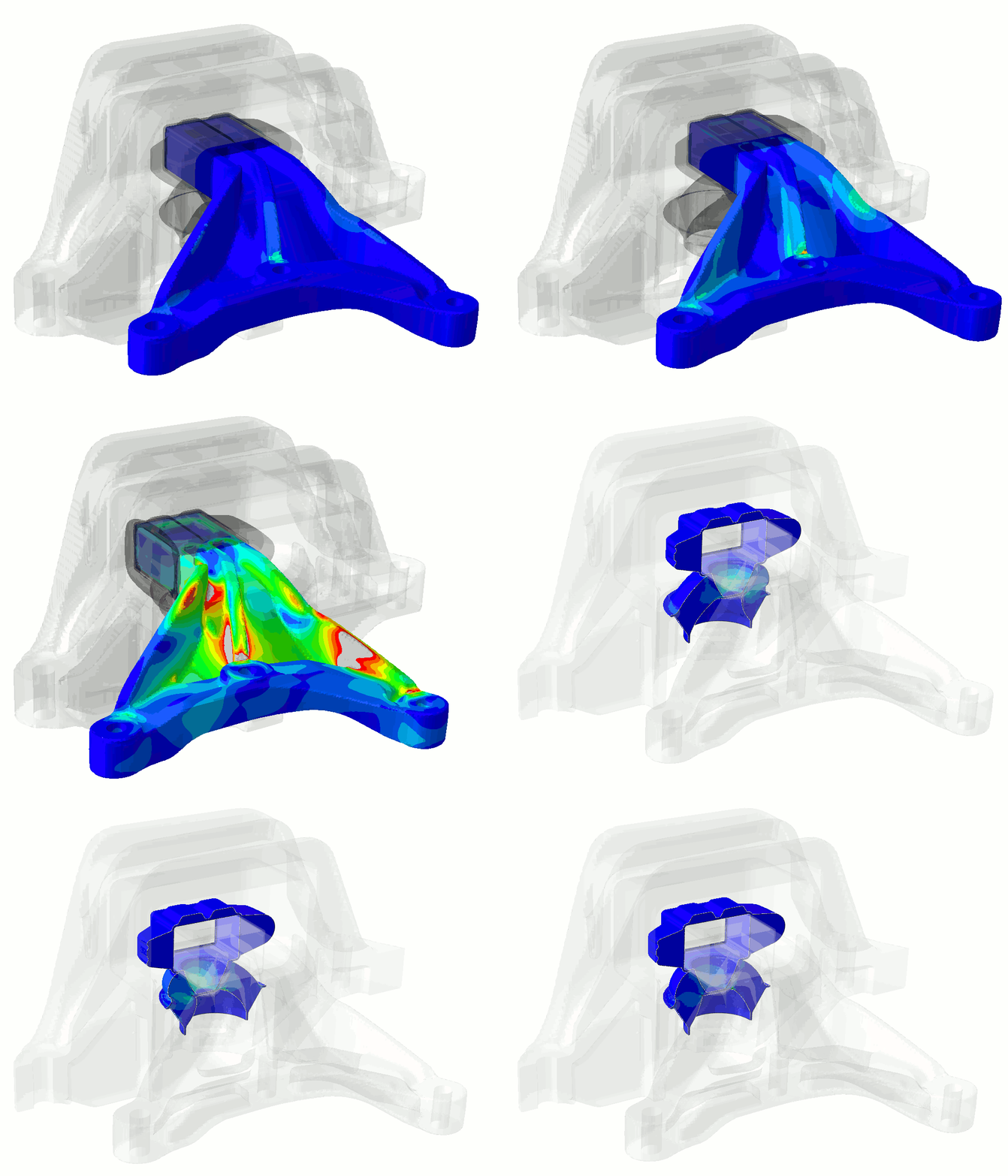
Hexahedral meshing of complex geometries
The quality of a simulation directly depends on the preparation of the model, and in particular on the mesh. It affects the accuracy of the results, calculation times and the ability to achieve convergence, especially in the presence of severe nonlinearities (large deformations, contacts, etc.).
Hexahedral finite elements generally offer better performance than tetrahedral elements in terms of accuracy and deformation consistency.
HEXAMECA specialises in the hexahedral meshing of complex geometries, thanks to an internally developed method making it possible to:
- make the performance of hexahedral elements accessible to all types of geometries,
- guarantee mesh quality,
- reduce implementation times, making this approach compatible with industrial lead-time constraints.
This expertise makes it possible to obtain robust and reliable numerical models, suited to demanding calculations.
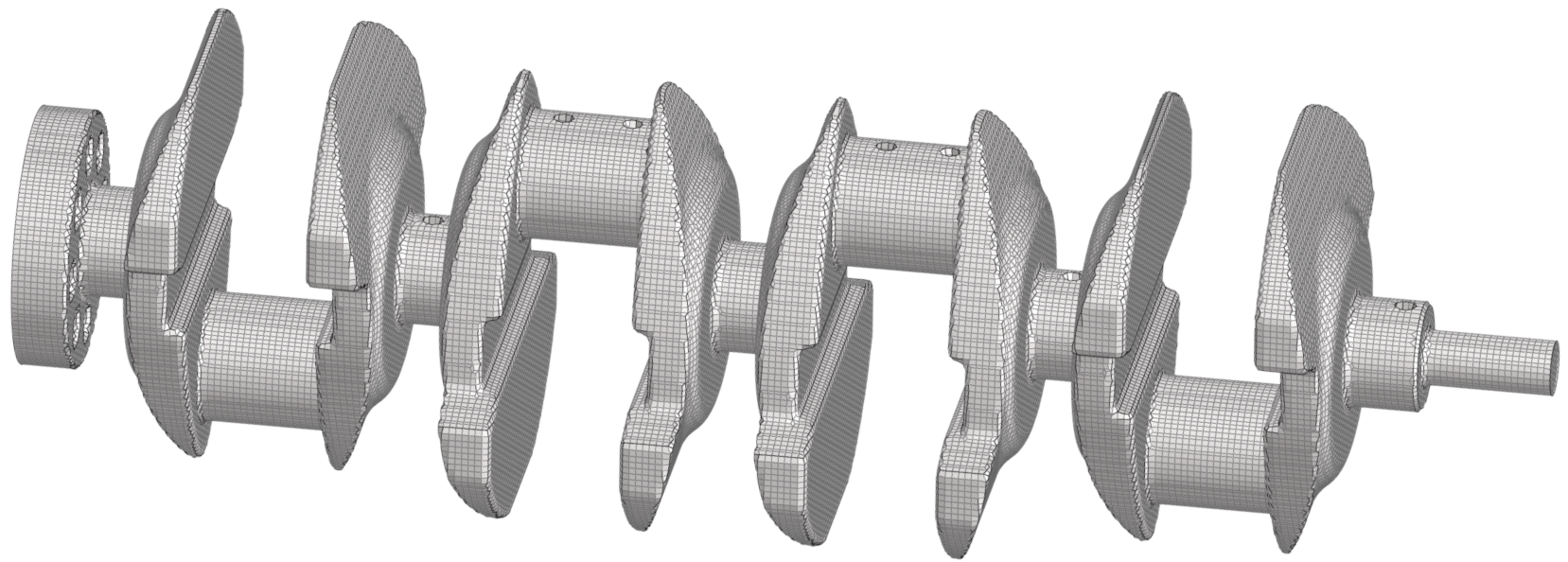
We also handle the meshing of geometries obtained from 3D scans, by tomography or other techniques, without prior CAD reconstruction. This approach enables you to quickly analyse existing parts, work on real geometries resulting from production and facilitate comparative analyses and benchmarking. It is an effective tool for improving responsiveness during the validation phase.
Development of dedicated engineering tools
HEXAMECA develops dedicated numerical tools aimed at structuring, accelerating and securing calculation and design processes, in connection with numerical simulation methods. These tools notably make it possible to:
- automate calculation or post-processing tasks,
- exploit simulation results based on structured databases,
- implement geometry optimisation methods,
- develop design-support tools integrating predictive models.
These developments are carried out tailor-made, depending on the issues encountered, and are integrated directly into existing processes.
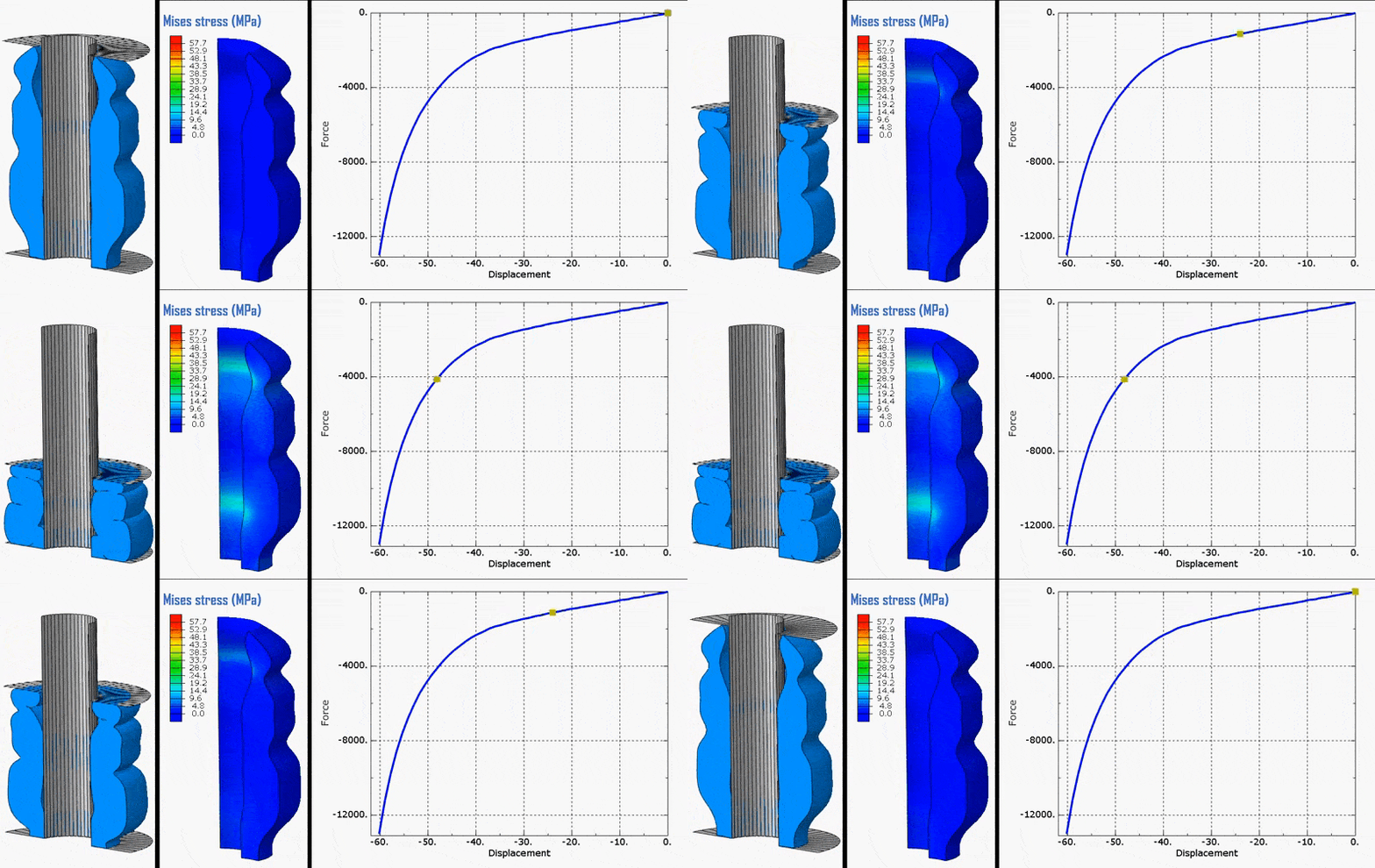
⇒ Example of application: design-support tool for jounce bumpers
HEXAMECA has developed a real-time prediction tool for the mechanical behaviour of jounce bumpers, based on neural-network-type learning models and a database generated from numerical simulations. This example illustrates our ability to develop design-support tools adapted to complex industrial issues.
Link with torsional vibration calculations
Expertise in numerical simulation, advanced modelling and the development of dedicated tools forms the foundation of the torsional vibration calculations (TVC) carried out by HEXAMECA in the marine sector.